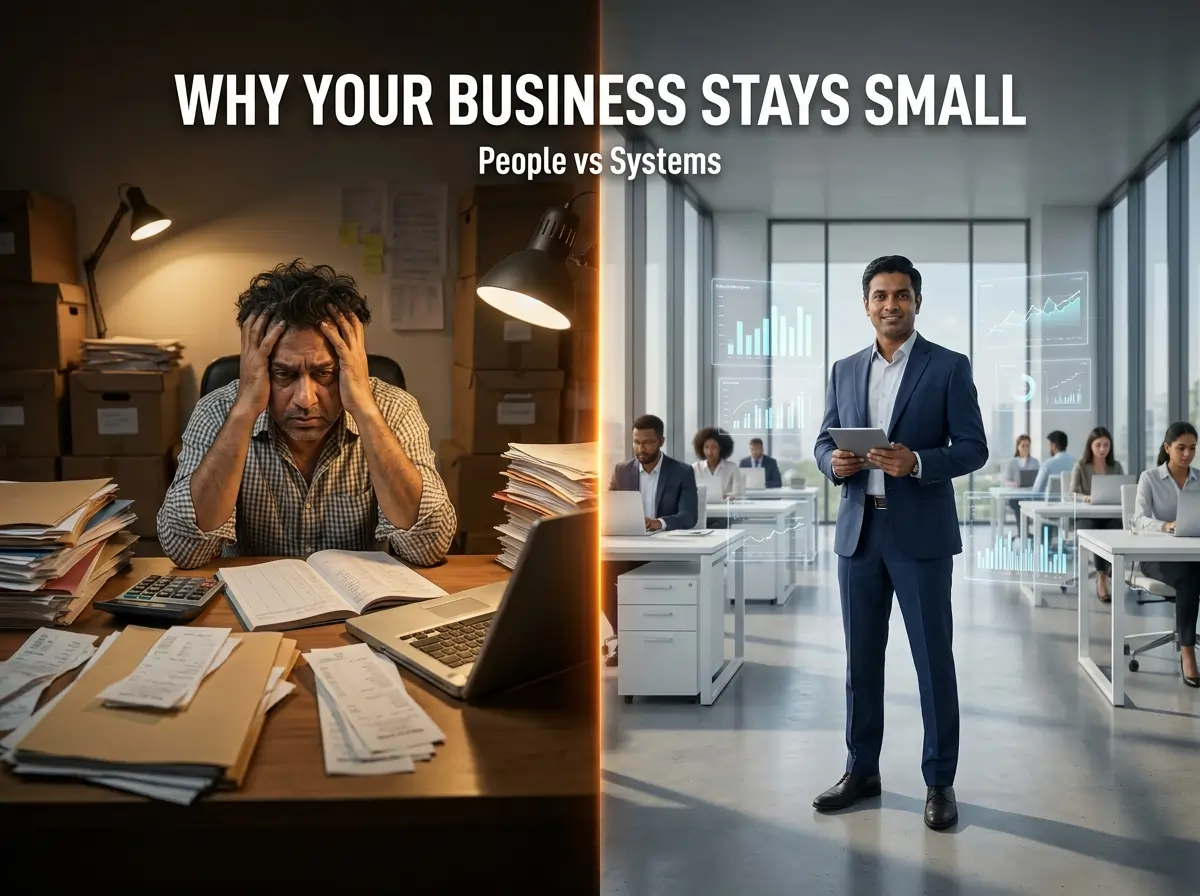
I often walk into two very different worlds. In one, the business revolves around a single person’s energy; in the other, the business runs on a rhythmic, invisible architecture.
The fundamental reason self-employed businesses fail to scale into corporate giants isn’t a lack of hard work or talent. It is the “Founder’s Trap.” Self-employed businesses rely on humans; corporate houses rely on systems.
Contents
- 1 The Core Difference: Dependence vs. Scalability
- 2 1. The Power of a Systematic Approach
- 3 2. Internal Controls: The Guardrails of Growth
- 4 3. Risk Assessment: Proactive vs. Reactive
- 5 4. Delegation of Power: Let Go to Grow
- 6 5. Review of Control Testing: Keeping the Engine Tuned
- 7 Why “Human-Reliance” is a Technical Debt
- 8 Transitioning from Self-Employed to Corporate
- 9 Conclusion
The Core Difference: Dependence vs. Scalability
In a self-employed model, the business is an extension of the individual. If the owner is sick, the business is “sick.” If the owner is on vacation, the business halts.
Conversely, a corporate house is a legal and operational entity that exists independently of any one person. It is built on the Three Lines Model, where management, risk oversight, and independent assurance (audit) work in harmony.
The Growth Ceiling
- Self-Employed (The Human-Centric Model): Decisions are based on gut feeling. Records are often kept in the owner’s head or a messy spreadsheet. Growth is limited by the owner’s physical hours and mental bandwidth.
- Corporate (The System-Centric Model): Decisions are based on data. Processes are documented. Growth is limited only by market demand and capital, because the “engine” can be replicated.
1. The Power of a Systematic Approach
Corporates treat every task as a “process” rather than a “chore.” Whether it’s hiring a clerk or buying a $10 million machine, there is a Standard Operating Procedure (SOP).
When a business is systematic, it becomes predictable. Predictability is what allows a business to attract investors and banks. If your business results depend on your “mood” or “memory,” no one will fund your expansion.
2. Internal Controls: The Guardrails of Growth
Many small business owners view “Internal Controls” as red tape. In reality, they are the brakes that allow a car to go faster.
Internal Controls are the policies and procedures that ensure:
- Financial reports are reliable.
- Operations are efficient.
- Laws are followed.
The “Human” Error: In a self-employed business, the owner often says, “I trust my accountant.” In a corporate house, they say, “I trust the process, but I verify the controls.” Trust is not an internal control. Without automated checks and balances, the risk of fraud and error increases exponentially as you add more staff.
3. Risk Assessment: Proactive vs. Reactive
Most self-employed individuals are “firefighters.” They wait for a problem to happen and then rush to fix it.
Corporate houses perform regular Risk Assessments. As a specialist, I look at:
- Inherent Risks: Risks existing before any controls (e.g., market volatility).
- Control Risks: The risk that a system failure will occur.
- Residual Risks: What remains after we’ve done our best.
By identifying what could go wrong before it does, a corporate house protects its capital. A self-employed business often loses its entire year’s profit to a single unmanaged risk, such as a tax penalty or a bad debt.
4. Delegation of Power: Let Go to Grow
This is the hardest hurdle for the self-employed. They suffer from the “Only I can do it right” syndrome.
Corporate houses use a Delegation of Power (DoP) matrix. This document clearly defines:
- Who can sign a check?
- Who can approve a discount?
- Who can hire a new employee?
By delegating authority (not just tasks), the CEO of a corporate house frees their time for Strategic Thinking. If you are a business owner still signing every $50 invoice, you aren’t a CEO—you are a high-paid clerk.
5. Review of Control Testing: Keeping the Engine Tuned
In the corporate world, we don’t just set a rule and forget it. We perform Test of Operating Effectiveness (ToE).
We ask: “We have a rule that two people must sign every purchase order. Is this actually happening?”
- The Audit Trail: Corporates create a “paper trail” (or digital log).
- Continuous Monitoring: They use data analytics to spot outliers.
The self-employed business owner assumes that because they told someone to do something, it is being done. This lack of “Review of Control” is where most small businesses bleed money through inefficiency and “leakage.”
Why “Human-Reliance” is a Technical Debt
When you rely on a specific human (including yourself), you are building Technical Debt.
- If that human leaves, the knowledge leaves.
- If that human is tired, the quality drops.
- If that human is dishonest, the business collapses.
Systems don’t get tired. Systems don’t have bad days. Systems can be audited.
Transitioning from Self-Employed to Corporate
To grow like a corporate house, you must stop working in your business and start working on it.
Step 1: Document Everything
If a task is done more than twice, it needs an SOP. This allows you to hire someone and train them to your exact standard.
Step 2: Segregate Duties
The person who records the sales should not be the person who handles the cash. This simple internal control prevents 90% of small business fraud.
Step 3: Implement Risk-Based Auditing
Every quarter, look at your biggest “worries.” Is it your supply chain? Your IT security? Your tax compliance? Build a control to mitigate that specific worry, and then test it.
Conclusion
The path from a one-person shop to a corporate giant is paved with Systems, Controls, and Data. Corporate houses don’t grow because they have more money; they have more money because they built a system that can handle growth. If you want to scale, you must replace your reliance on “the right person” with “the right process.”
Stop being the engine of your business. Start being the architect.
Final Thoughts for the Commerce Professional
As auditors and accountants, our job isn’t just to “check the boxes.” It is to help businesses build these architectures. When we recommend a Risk Assessment or a Control Review, we aren’t adding a burden—we are providing the blueprints for a bigger building.
Is your business built on the shifting sands of human effort, or the solid rock of a systematic approach?